
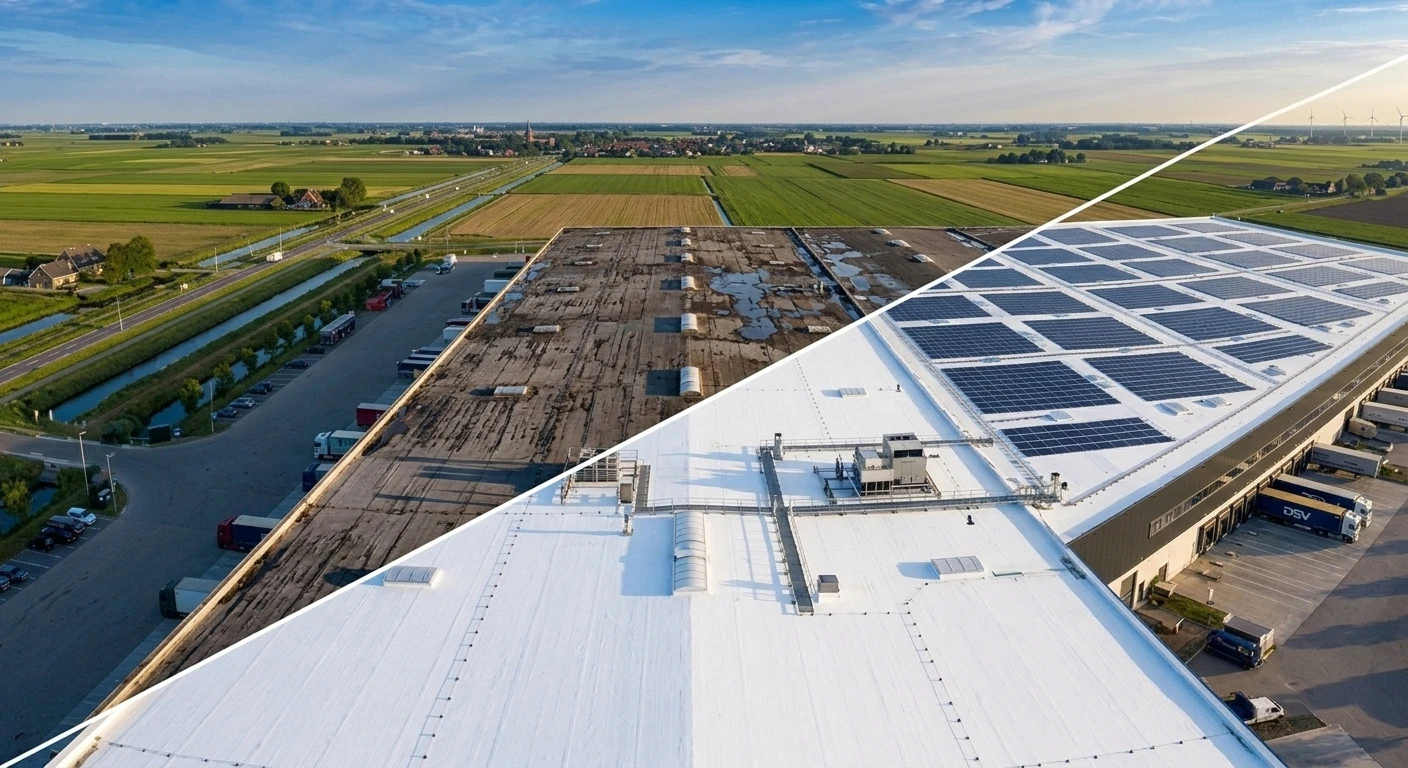
Traditional roof coverings such as bitumen, EPDM, and PVC have been the standard on commercial buildings for decades. But that standard is shifting. Silicone roof coating is rapidly gaining ground as the more sustainable, safer, and more cost-effective alternative. Not without reason: the material outperforms its fossil-based predecessors on virtually every measurable metric.
What exactly is silicone roof coating?
Silicone roof coating is a liquid-applied membrane based on alkoxy silicone polymer technology. It is airless-sprayed under high pressure (around 300 bar) and forms a seamless, 100% waterproof, vapor-permeable membrane after curing. Unlike bitumen or PVC, the material is not based on petroleum but on silica — quartz sand. That makes it free of BPA, solvents, and toxic substances.
The raw material silica (SiO₂) is one of the most abundant minerals on Earth. At end of life, silicone roof coating breaks down into nothing but sand and lime upon recycling. That makes the material fully circular — a property no traditional roofing covering can match.
Five reasons silicone roof coating is the better choice
1. Longer lifespan, higher warranty
Where the industry standard for roofing warranties hovers around 10 years (VEBIDAK norm), GE Momentive offers warranties of 15, 20, or 25 years on silicone roof coating with the Enduris 3500 system. The proven lifespan exceeds 40 years — the first silicone roof was applied back in 1967. Since then, the system has been applied worldwide on more than 10 million m².
The reason for that exceptional lifespan: 100% alkoxy silicones are fully UV-stable. There are no plasticizers that leach out over time, which means cracking — the typical aging signature of bitumen and PVC — simply does not occur. With 542% elasticity, the membrane remains permanently flexible, even under extreme temperature swings.
2. Flame-free working per NEN 6050
One of the biggest risks with traditional roof renovation is fire. Bitumen is applied with open flame, at temperatures up to 1,000 degrees. ABN AMRO Insurance estimates that 80% of all roof fires occur during roof maintenance.
Silicone roof coating is applied cold — fully without open flame. This complies with NEN 6050 (flame-free working) and eliminates fire risk during installation. The material itself has fire class A (UL 790 + ASTM E84/108), is FM Approved (Class 4470), and is certified to Broof t1-t4 and ETA-18/0472.
3. No removal of the old roof covering
With traditional roof renovation, the existing roof covering must be removed and hauled away. That takes time, money, and brings additional risks — from crane work to waste processing.
Silicone roof coating is applied directly over the existing roof covering. It is the only material that can directly overlay bitumen, EPDM, PVC, TPO, concrete, and steel roof decks. That not only saves removal costs, but also halts the aging of the underlying layer. The result is a complete renovation that is up to five times lighter than a bitumen solution.
4. Cool Roof: up to 35% lower cooling load
Silicone roof coating reflects 88% of sunlight, with a Solar Reflectance Index (SRI) of 111. By comparison: a black roof gets 40 to 50°C hotter than the outside temperature on a sunny day. A white silicone roof gets only 5 to 10°C hotter.
The practical result, according to the Lawrence Berkeley National Laboratory: an indoor temperature that is 3 to 6 degrees lower and a reduction in cooling load of up to 35%. That translates directly into lower energy costs and a more comfortable working environment.
5. Higher solar panel yield
For companies with solar panels on the roof, silicone roof coating delivers an extra bonus. For monofacial panels, the lower roof temperature results in up to 15% higher yield — every 10°C rise costs roughly 5% in power output.
For bifacial solar panels, the effect is even greater. On behalf of Cool Roof Coatings, TNO tested the CRC-PV-3502 silicone coating and measured yield gains of 15% to 17% compared to installation on black, low-albedo roofs.
Certifications and quality marks
Not all silicone roof coatings are equal. The GE Enduris 3500 system stands out with an extensive set of certifications:
- FM Approved Class 4470
- Broof t1-t4 (EN-13501-5:2016)
- ETA-18/0472 (European Technical Assessment)
- Fire class A (UL 790 + ASTM E84/108)
- NEN 6050 compliant (flame-free working)
Installation is carried out exclusively by certified applicators with VCA-VOL crews, in accordance with strict GE Silicones installation specifications. The official GE Limited Product Warranty is only valid when installation is performed by a recognized party with the Cool Roof Coatings quality mark.
Total Cost of Ownership
The initial investment in silicone roof coating is comparable to or lower than a full traditional roof renovation — especially when you factor in the costs of removal, disposal, and crane work. But the difference shows over the long term: a 40+ year lifespan, warranties up to 25 years, lower energy costs through heat reflection, higher PV yield, and the elimination of future renovation cycles.
What is more, silicone roof coating is renewable layer over layer. After the warranty period, a new top layer can simply be applied — without removing the existing coating. In practice, that makes the system infinitely renewable.
Conclusion
Silicone roof coating combines what traditional roof coverings cannot: fire safety, durability, energy savings, and a lifespan that more than recovers the investment. For companies serious about sustainability, it is no longer an alternative — it is the logical choice.